Date: 28 August 2026
Prepared for: Importers, Manufacturers, Suppliers and Buyers of Cosmetic Products for the EU Market
EU Safety Gate Cosmetics Recalls - 2026 YTD Analysis
Between January and 28 August 2026, the EU Safety Gate rapid alert system recorded a total of 504 cosmetic product alerts. This sustained volume reflects the ongoing enforcement focus of national market surveillance authorities across the EU.
For businesses supplying cosmetic products to the European market, understanding the patterns emerging from these alerts is essential for effective compliance planning. This analysis examines the key trends from the 2026 data, including country of origin, product category, and reason for recall.
1. Country of Origin (COO) Distribution
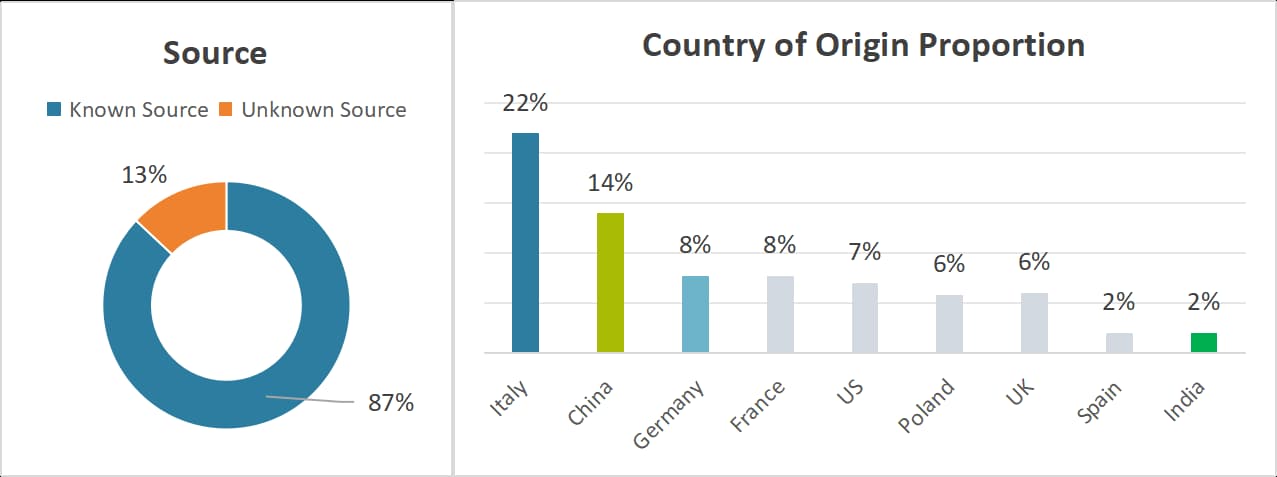
Among the 504 recalled cosmetic products, the country of origin was unknown in 64 cases (13%). The substantial proportion of products with an unknown country of origin highlights persistent traceability gaps in the cosmetics supply chain.
Among traceable products, Italy ranked highest with 109 cases (22%), followed by People's Republic of China with 71 cases (14%), Germany with 39 cases (8%) and France with 38 cases (8%). The top 10 countries of origin are presented below.
2. Product Category Distribution
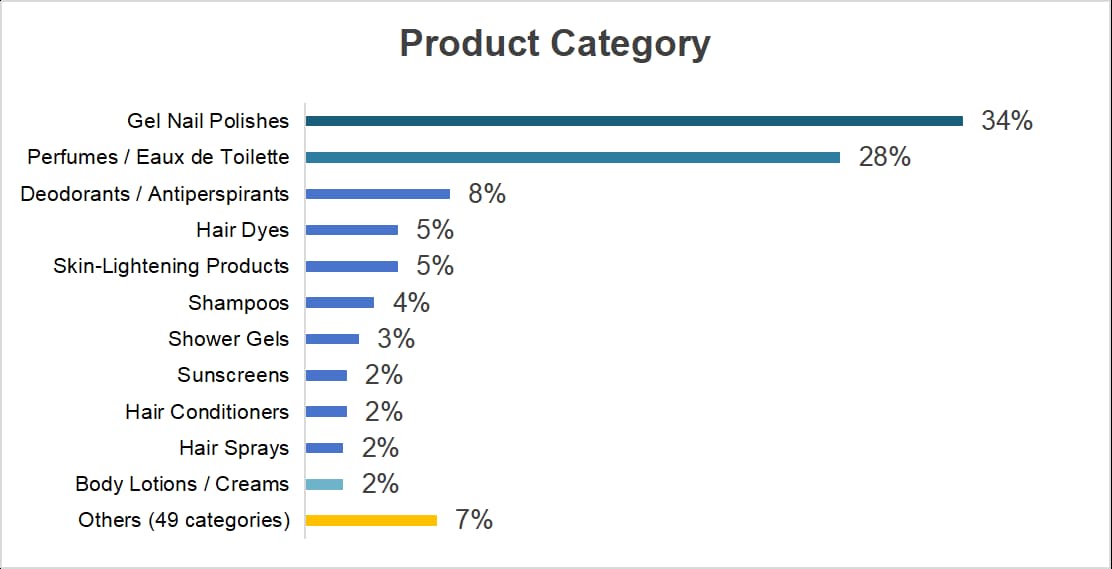
Gel nail polishes were the most frequently recalled product category, with 171 cases (34% of total alerts). Perfumes and eaux de toilette ranked second with 139 cases (28%), followed by deodorants/antiperspirants with 38 cases (8%), hair dyes with 24 cases (5%), and skin-lightening products with 24 cases (5%).
Gel nail polishes and perfumes together accounted for 61.5% of all cosmetic alerts, reflecting both the high volume of these products on the market and the specific regulatory focus on nail product and fragrance allergens.
3. Reason for Recall Analysis
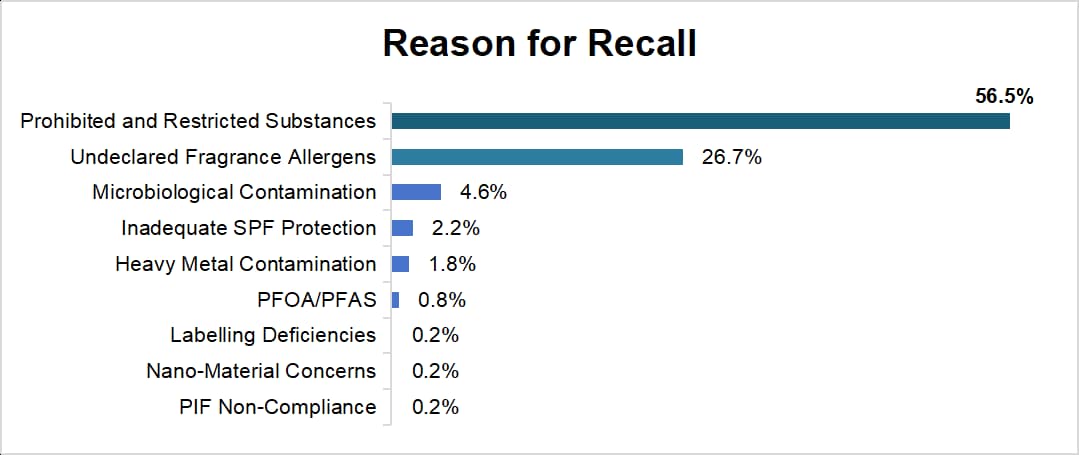
Top 2 reasons (Prohibited Substances & Undeclared Allergens) account for 83.2% of all recalls, indicating regulatory compliance and ingredient disclosure are the primary risks.
l Prohibited and restricted substances were the leading cause of recalls, accounting for 285 cases (56.5%).
l Undeclared fragrance allergens ranked second with 135 cases (26.7%).
l Microbiological contamination accounted for 23 cases (4.6%).
l Inadequate SPF protection accounted for 11 cases (2.2%).
l Heavy metal contamination accounted for 9 cases (1.8%).
l PFOA/PFAS accounted for 4 cases (0.8%).
l Labelling deficiencies (missing safety warnings) accounted for 1 case (0.2%).
l Nano-material concerns accounted for 1 case (0.2%).
l PIF non-compliance (missing safety files, analysis certificates, or stability reports) accounted for 1 case (0.2%).
3.1 Prohibited and Restricted Substances (285 cases, 56.5%)
In the EU, cosmetic ingredient usage must comply with Regulation (EC) No 1223/2009:
l Substances listed in Annex II (prohibited substances) must not be used;
l Substances listed in Annex III (restricted substances) may only be used under specified conditions;
l Colorants, preservatives, and UV filters must comply with Annexes IV to VI respectively.
The following substances were those most commonly identified in 2026 alerts:
l BMHCA (Lilial) – The most frequently cited prohibited substance. Prohibited under Annex II via Regulation (EU) 2021/1902, effective from 1 March 2022. A CMR substance that may harm the reproductive system, harm the health of the unborn child, and cause skin sensitisation.
l TPO (Trimethylbenzoyl Diphenylphosphine Oxide) – Frequently found in gel nail polishes. Added to Annex II via Regulation (EU) 2025/877, effective from 1 September 2025. May harm the reproductive system and cause allergic skin reactions.
l Formaldehyde – Found in hair-straightening and keratin treatment products. A skin sensitiser and potential carcinogen.
l Hydroquinone – Found in skin-lightening creams. Prohibited in cosmetic products under Annex II.
l Clobetasol Propionate – A corticosteroid found in skin-lightening products. Should only be applied under medical prescription.
l MCI/MI – Found in leave-on products where are prohibited. Severe skin and eye irritants.
l HICC – A prohibited fragrance allergen, frequently found alongside BMHCA in perfumes.
l Safrole – A genotoxic substance that can cause liver cancer and skin irritation.
l D4 (Octamethylcyclotetrasiloxane) – Prohibited in leave-on cosmetics due to reproductive toxicity.
l Pyrithione Zinc – Prohibited due to reproductive toxicity concerns.
l Cloprostenol isopropyl ester – A prostaglandin analogue found in eyelash serums. Should only be used under ophthalmological supervision and is not permitted in cosmetics.
l Phthalates – Found in a bath bomb set; linked to reproductive toxicity in children.
l Benzophenone – A prohibited UV filter and potential carcinogen.
l THC/CBD – Narcotic substances listed under Annex II.
l Phenol – A corrosive and potentially mutagenic substance.
3.2 Undeclared Fragrance Allergens (135 cases, 26.7%)
Regulation (EC) No 1223/2009, Article 19(1)(g), requires that fragrance allergens be labelled when their concentration exceeds 0.001% in leave-on products and 0.01% in rinse-off products. This requirement applies to 24 core fragrance allergens, with an extended list of 81 allergens becoming mandatory from 31 July 2026 for new products under the EU Regulation.
In 2026, undeclared fragrance allergens – particularly BMHCA (often cited both as a prohibited substance and as an undeclared allergen), HICC, benzyl alcohol, geraniol, linalool, limonene, and citronellol – were consistently identified across perfumes, deodorants, shampoos, body lotions, and other fragranced products.
3.3 Microbiological Contamination (23 cases, 4.6%)
Products contaminated with microorganisms such as Pseudomonas aeruginosa, Burkholderia cepacia, Enterobacter gergoviae, Candida albicans, and other mesophilic aerobic bacteria were detected in various product categories, including shower gels, hand soaps, baby wipes, and mouthwash. These microorganisms may pose health risks, particularly to consumers with weakened immune systems. Cases involving preservative system failure have been included in this category.
3.4 Inadequate SPF Protection (11 cases, 2.2%)
Sunscreen products failing to deliver the declared Sun Protection Factor (SPF) level were identified. These products may expose consumers to sunburn and long-term risks including immunosuppression, premature skin ageing, and skin cancer.
3.5 Heavy Metal Contamination (9 cases, 1.8%)
Contamination with lead, mercury, cadmium, arsenic, and antimony was detected – primarily in cosmetics from non-EU origins such as eyeliner powders, skin-lightening creams, and cosmetic powders. Under Article 17 of the Cosmetic Products Regulation, while trace amounts of prohibited substances may be technically unavoidable under GMP, the Cosmetic Product Safety Report must demonstrate that the product remains safe for human health.
Reference limits commonly applied with reference to BVL (2016) Technically avoidable heavy metal contents in cosmetic products :
Heavy Metal | Limit | Remarks |
Lead (Pb) | ≤ 5.0 mg/kg | Make-up powders, rouge, eyeshadow, eyeliner, kajal, theater, fan or carnival make-up |
≤ 0.5 mg/kg | Toothpaste |
≤ 2.0 mg/kg | Other products |
Mercury (Hg) | ≤ 0.1 mg/kg |
|
Cadmium (Cd) | ≤ 0.1 mg/kg |
|
Arsenic (As) | ≤ 2.5 mg/kg | Theater, fan or carnival make-up |
≤ 0.5 mg/kg | Toothpaste and others |
Antimony (Sb) | ≤ 0.5 mg/kg |
|
Soluble Nickel | 10 ppm | From German Health Journal No.28, July 1985 |
It is worth noting that many retailers and brand owners apply significantly
stricter thresholds to meet their own quality standards. The following limits are being adopted by some major buyers as part of their supplier requirements:
Heavy Metal | Limit | Remarks |
Nickel (Ni) | ≤ 1.0 mg/kg |
|
Chromium (Cr) | ≤ 1.0 mg/kg |
|
Cobalt (Co) | ≤ 0.1 mg/kg |
|
3.6 PFOA/PFAS (4 cases, 0.8%)
Eye and lip products containing perfluorononyl dimethicone – a PFOA-related compound – were identified. PFOAs pose risks to human health and the environment under the Persistent Organic Pollutants (POP) Regulation and REACH.
3.7 Labelling Deficiencies (1 case, 0.2%)
One product was found to lack appropriate instructions for safe use and the necessary labelling. Proper labelling ensures that consumers can use the product safely and make informed choices.
3.8 Nano-Material Concerns (1 case, 0.2%)
One product was found to contain carbon black in nano-form at an excessive concentration, posing potential health risks. Under the Cosmetic Products Regulation, nanomaterials must be clearly labelled and undergo specific safety assessments before being placed on the market.
3.9 PIF Non-Compliance (1 case, 0.2%)
One product was found to lack compliant safety files, analysis certificates, and stability reports. Under the Cosmetic Products Regulation, the Responsible Person must maintain a Product Information File (PIF) containing safety assessments, test reports, and product specifications. Without this documentation, the product cannot be legally placed on the EU market.
4. Key Origin Markets Analysis – China, India, South Korea and Southeast Asia
In recent years, the cosmetics supply chain has increasingly diversified, with India, South Korea and Southeast Asian countries alongside China emerging as significant manufacturing hubs for products destined for the EU market. This shift is driven by tariff, cost advantages, expanding production capacity, and supply chain management. While South Korea and Southeast Asia each recorded only 1-2 recalls in 2026, their inclusion offers a reference point for businesses already sourcing from, or evaluating suppliers in, these regions – particularly as export volumes to the EU grow. The following analysis covers these origins, with China as a benchmark.
4.1 Product Category Distribution
Among these origin markets, gel nail polishes dominated recalls (47.6% of combined origin cases), driven almost entirely by China-origin products.
Perfumes (6.9%), sunscreens (5.2%), and skin creams/lotions (5.2%) were the next most frequently cited categories. India contributed a diverse range of products including hair dyes, skin creams, and perfumes, while South Korea and Southeast Asia each had limited representation in the dataset.
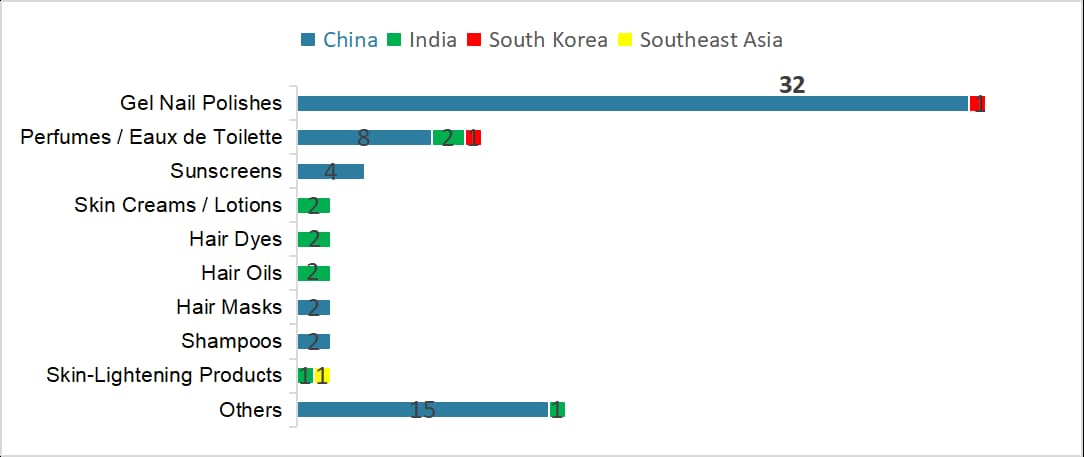
Note: "Others" for China (15 cases) includes: Hair Conditioner (1), Hand Cream (1), Skin Foundation (1), Teeth Whitening Pen (1), Eyeliner (1), Hair Cream (1), Hair Spray (1), Hair Gel (1), Cosmetic Powder (1), Hair Oil (1), Shower Gel (1), Bath Foam (1), Body Lotion (1), Lip Gloss (1), Moisturiser (1). And "Others" for India includes: Cosmetics Powder (1), South Korea and Southeast Asia have no "Others" categories – all cases are accounted for in the listed categories.
4.2 Reason for Recall Distribution
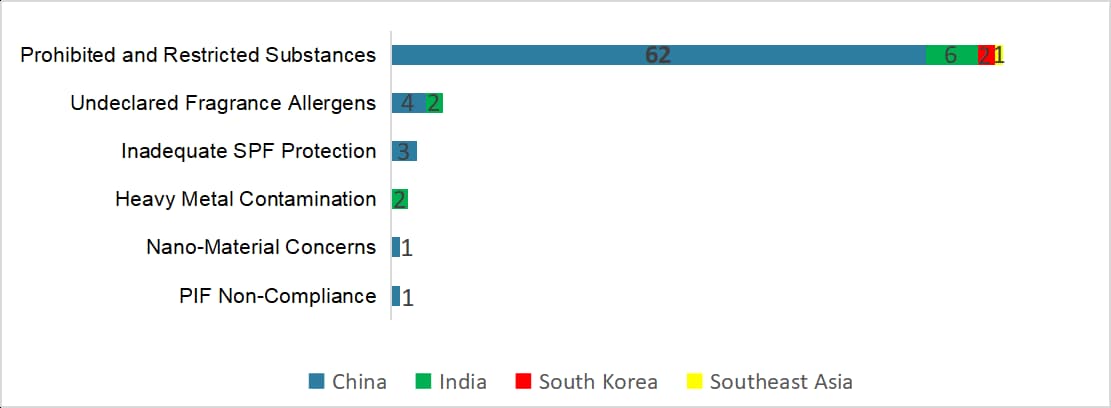
Prohibited and restricted substances were by far the leading cause of recalls across all four origin markets, accounting for 84.5% of cases. Among China-origin products, this was driven primarily by TPO in gel nail polishes and D4 in leave-on products. In India-origin products, the substances included BMHCA in perfumes and skin creams, PPD in hair dyes, and mercury in skin-lightening creams. South Korea had two cases: one involving TPO in a gel nail polish and one involving BMHCA in a hand cream, while Southeast Asia (Thailand) had one case involving BMHCA in an eau de toilette. Undeclared fragrance allergens accounted for 7.1%, while heavy metal contamination accounted for 2.4% (both from India-origin products). This distribution suggests that while supply chains are diversifying, the core compliance challenges – particularly around prohibited substances and labelling – remain consistent across regions.
What This Means for You
For importers and manufacturers, the data shows that the majority of recalls stem from a small number of well-documented issues. If you are sourcing or manufacturing for the EU market, the following actions are relevant:
1. BMHCA and TPO are not obscure substances. BMHCA has been prohibited since 2022; TPO since September 2025. Yet together they still account for a substantial portion of alerts – suggesting that many suppliers have not yet conducted a thorough formulation review. If you have not already done so, this is the most immediate and practical step you can take.
2. fragrance labelling is a manageable fix. The extended list of 81 allergens becomes mandatory for new products from 31 July 2026 and for existing products from 2028. This is not a distant requirement – it is already relevant to your planning.
3. Check preservative systems, particularly in leave-on products. MCI and MI remain prohibited in leave-on cosmetics, and microbiological contamination continues to trigger alerts. And validate sunscreen SPF claims with appropriate testing
For suppliers and buyers, the data also offers a practical lens for evaluating new manufacturing partners. As supply chains diversify into India, Southeast Asia, and other emerging hubs, the same compliance standards apply. A simple but effective question to ask any potential partner is: "Have you conducted a full regulatory assessment against the EU Cosmetic Products Regulation – including Annex II, Annex III, and Annex V?" The answer will tell you much about their readiness.
Ultimately, the 2026 Safety Gate data reinforces a simple truth: the majority of recalls stem from well-documented, long-standing requirements – not from new regulations. A thorough review of your formulations, ingredient documentation, and labelling remains the most effective way to reduce risk and maintain smooth market access. It is not about reacting to change; it is about getting the fundamentals right.
Reference:
Regulation (EC) No 1223/2009 of the European Parliament and of the Council on cosmetic products (recast)
Regulation (EU) 2021/1902 – Prohibition of BMHCA (Lilial) in cosmetic products
Regulation (EU) 2025/877 – Prohibition of TPO in cosmetic products
Regulation (EU) 2024/1978 – Expansion of fragrance allergen labelling requirements (Omnibus Regulation)
Safety Gate: the EU rapid alert system for dangerous non-food products – https://ec.europa.eu/safety-gate-alerts/
© 2026 EASYHARMONY TECHNOLOGY CO., LIMITED (EHC). All rights reserved.